









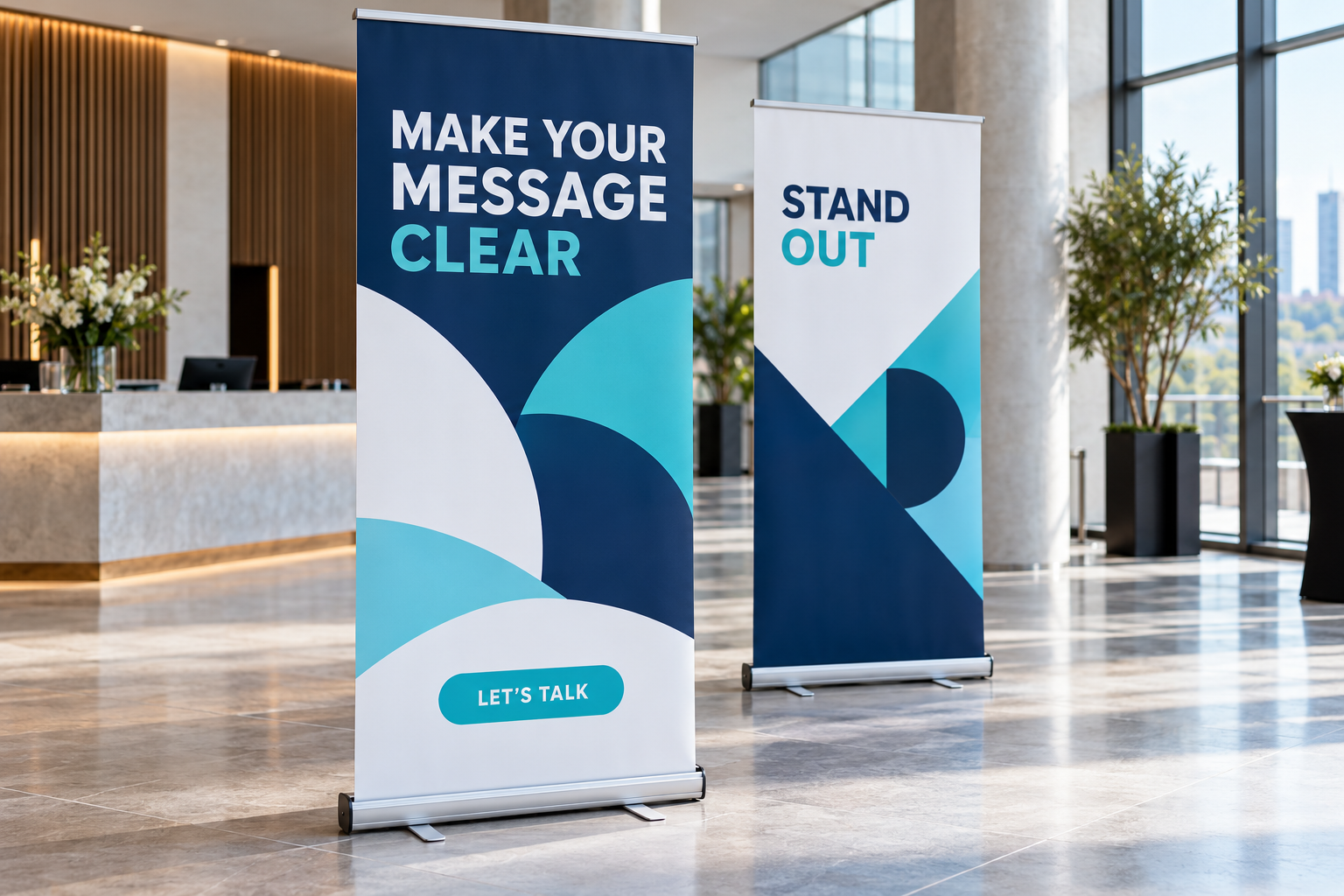
What should you put on a pull-up banner? Start with one clear message, an identifiable brand, a strong visual and an obvious next step. A successful pull-up banner design helps someone understand your offer while walking past, then gives interested readers enough information to continue the conversation.
That sounds simple until several departments want space on the same display. A service list becomes a paragraph, the paragraph becomes smaller type, and the contact information ends up near the floor. The finished banner may contain everything the business wants to say while making the main point difficult to find.
Whether you need a stand up banner for a reception area, an exhibition or a seasonal promotion, planning the reader’s experience before designing the artwork can make the result more useful.
Understand the Display You Are Ordering
Pull-up, roll-up and retractable banner are commonly used names for a display with a printed graphic that extends from a base and is supported upright. However, “pop-up display” can also describe a larger exhibition system. Confirm the actual product rather than relying on the name alone.
The graphic, base, support mechanism and carry arrangements should suit how the display will be used. A banner transported to frequent events has different requirements from one that remains in the same reception area.
Print Three’s roll-up banners include different hardware options. Ask which model suits your intended setting, whether graphics can be replaced, and what the supplied template requires. Graphic replacement is not a feature of every retractable banner stand.
Give the Banner One Main Job
Before opening a design file, complete this sentence: “After seeing this banner, we want the reader to…”
The answer might be to visit a demonstration, ask about one service, find a registration desk or explore a product range. That decision determines what deserves the largest space.
For example, an exhibitor offering several software services could use a banner to introduce one business problem and invite a demonstration. The full feature list belongs in a brochure or conversation. A reception banner might instead help arriving visitors identify the organization and understand its main services.
Keep the headline aligned with the action. If the display promotes an event, the event name and reason to attend should be clear. If it provides directions, the destination and arrow matter more than a long brand statement.
Write a Headline People Can Understand Quickly
A headline should explain something meaningful to the intended reader. Broad phrases such as “Solutions for Tomorrow” may sound polished but leave a visitor unsure what the business actually does.
As an illustrative example, a commercial maintenance company could replace a vague slogan with “Keep Your Building Running.” A supporting line could identify the relevant service category. The message becomes easier to interpret without becoming a complete sales presentation.
Write several headline options before settling on the layout. Read each aloud and ask whether someone unfamiliar with the company would understand it. If the explanation only works after a staff member adds context, revise the words.
Arrange Information Around What People Can See
The full printed surface is not equally visible in every setting. A table, product display, chair or group of visitors may cover the lower portion. Some artwork also extends into the retractable mechanism and is not intended to be displayed.
Place the brand and main message where they remain visible in the planned installation. Use the centre for a strong image, a short explanation or a small number of benefits. Keep secondary details lower down only if they will still be practical to read.
Do not use a generic “top, middle, bottom” formula without looking at the setting. A banner beside a registration desk may need different positioning from one behind an exhibition table. Ask the event organizer for booth dimensions and photograph the intended location when possible.
Make Readability a Design Requirement
A banner can look attractive on a laptop and still be difficult to read across a room. Type size, contrast, image detail and the amount of competing content all affect how it works at a distance.
Choose clear typefaces and avoid long passages in decorative lettering. Keep essential text away from busy photographs. Where a picture has changing light and dark areas, a solid colour panel behind the wording may provide more reliable contrast than a subtle shadow.
There is no universal font size that works for every display. The physical size, viewing distance, lighting and typeface all matter. Review the headline and main message at approximately their intended scale, then step back. The test is whether the information can be read comfortably where visitors are likely to stand.
Choose a Visual That Supports the Message
One useful photograph or illustration can do more work than several unrelated images. Show the product, setting or outcome that connects directly to the offer. Avoid filling space with graphics that require explanation.
Use the original image rather than a copy saved from social media. A file that looks sharp on a phone may have too few pixels for a large display. Ask the printer to assess effective resolution at the final output size and likely viewing distance.
Logos and simple graphics are usually best supplied as suitable vector artwork when available. A screenshot of a logo is a poor substitute for the approved production file, particularly when it must be enlarged.
Give Interested Readers One Clear Next Step
Once the banner has earned attention, tell the reader what to do. “Ask for a demonstration,” “Visit our display” or “Explore the collection” is more useful than several competing instructions.
A QR code can help when it leads to a relevant mobile page. Position it where someone can approach safely and scan without bending around furniture. Include a short written alternative, such as a memorable website address, so the code is not the only route forward.
Test the printed code at a realistic size and distance on more than one phone. Check that the destination loads, matches the offer and gives visitors a clear next step. If the banner will be reused, make sure the business can maintain the destination for that period.
Use the Correct Artwork Template
Confirm the hardware before finalizing the artwork. A retractable display may require specific trim dimensions, bleed, safe areas and extra material that sits inside the base. Those requirements vary by model.
Use the template supplied for the exact product. Keep text and logos out of hidden or unsafe areas. Follow the printer’s instructions for PDF export, colour settings, fonts and image handling, and clarify whether artwork is being supplied at full size or a specified scale.
Changing a file’s resolution setting alone does not recreate missing image detail. Similarly, stretching an existing poster into a narrow banner can distort the layout. Rebuild the design around the correct proportions rather than forcing an unrelated file to fit.
Match the Hardware to the Environment
Explain whether the banner will be used indoors, near an entrance or outside. A printed graphic described as weather-resistant does not automatically mean every base is suitable for wind or exposed locations.
Ask about stability, suitable surfaces and the manufacturer’s use instructions. Confirm any venue restrictions before installation. Do not add improvised weights or attachments that interfere with the mechanism or create a trip hazard.
For a reusable display, also consider transport and handling. Staff should know how to assemble it, retract the graphic without damage and store it in the appropriate case. A well-planned design still needs a display system that suits the working conditions.
Decide Which Information Should Stay Evergreen
A banner with a specific date, discount or employee name can become outdated quickly. That may be appropriate for a single campaign, but it should be a deliberate choice.
An evergreen brand banner can be paired with changeable brochures or other handouts containing current details. This lets the main display stay useful while offers evolve. If frequent graphic changes are important, discuss compatible hardware before ordering.
Review the cost of the complete display and its expected use. The lowest initial price may not provide the features needed for a busy event schedule. Conversely, a simple short-term display may not require a more elaborate system.
Review the Proof in Context
Before approval, check the company name, logo, headline, contact information and every link. Read the proof for meaning as well as spelling. An accurate address does not help if the call to action sends readers to an unrelated page.
Show the design to someone who was not involved in creating it. Ask what they think the banner is advertising and what they would do next. If their answer differs from the intended objective, simplify the message.
Finally, picture the display in its real setting. Check for furniture, competing signage, lighting and people who might block it. Those details often reveal problems that are invisible in an isolated artwork preview.
Frequently Asked Questions
Are pull-up banners and retractable banners the same thing?
The terms commonly describe the same general display format: a printed graphic that pulls out of a base and retracts for transport. Hardware features differ, so confirm the product specification.
How much text should a pull-up banner have?
Use enough to explain the main message and next step comfortably at the intended viewing distance. A headline, short supporting statement and limited contact information are often a practical starting point. Move detailed explanations to a handout or website.
Can I replace the graphic in an existing stand?
Some stands support replacement graphics and others do not. Provide the model, dimensions and condition of the existing hardware before ordering a replacement.
Can a retractable banner be used outside?
Only use a system suited to the actual outdoor conditions and follow its instructions. Confirm the base, graphic, wind exposure and installation requirements with the supplier.
Plan Your Next Banner With Print Three
A useful pull-up banner combines a focused message, readable artwork and suitable hardware. Start with the setting and intended action, then build the design around what visitors need to understand.
Explore Print Three’s roll-up banner options or contact Print Three to discuss your artwork, display environment and deadline.